
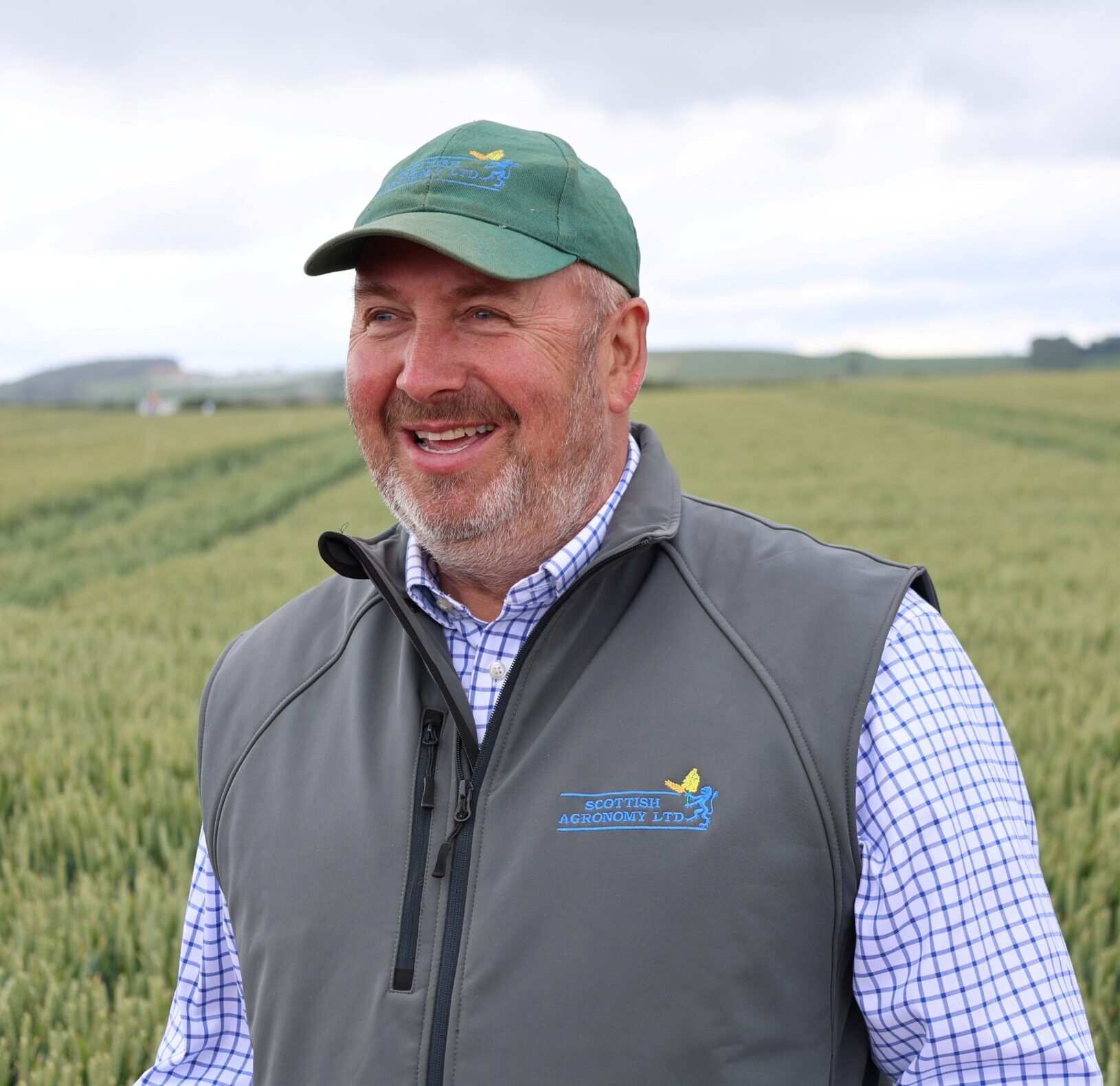
by Adam Christie
At times this year, Eastern Scotland felt like Kent in disguise! True, no two seasons are the same, but the harvest year just past is unique in many ways. Record breaking temperatures; long periods of reduced rainfall; and the vast majority of combines parked up in August with relatively straightforward spring and autumn drilling campaigns meant that the benign weather conditions made field operations as easy as I can remember.
Indeed, with only two exceptions, every time the trials team left base to complete a task this year, the weather was on their side. In a normal year, the joys of managing sites that can be as many as 150 miles from home mean that in the time it takes to travel that distance, conditions have changed for the worse and the operation is no longer possible. In a normal year we would expect as many as one in twenty journeys to need repeated to complete a task. This year, apart from those two occasions, the team completed the task every time. Cue a happy team and tasks completed at the right time and the right conditions.
Interestingly, when you look at the rainfall levels on our main sites, they are not far below expected totals. Our Borders and Fife sites show sub-800mm totals, which are in line with annual expectations. Our North site had almost 950mm, which was actually slightly wetter than the predicted total. The devil, as always, is in the detail. When you look at the frequency of rainfall, events tended to be heavier, but fewer, meaning far more dry days than we are used to. Record heatwaves in England smashed all temperature records. Whilst we were certainly warm, when you look at the weather data, we were not much warmer than average.
Rarely has the contrast between large parts of England and that which we have had to deal with been so great. Many Southern growers would have gladly swapped their desert-like conditions for our weather. While our crops were something of a mixed bag, large swathes of the south were little short of disastrous. If only this led to increased demand and price premiums. Instead, the realities of dealing with a world market had a very real effect on farm-gate prices. Much of the rest of the world enjoyed good growing conditions, with the result being plentiful supplies and depressed prices.
For most crops, yields were respectable. Winter Oilseed Rape was undoubtedly the star of the show, with some farm yields at levels thought to be impossible until only recently. Winter Barley and Winter Wheat, when well established in the autumn, rewarded well, helped by relatively low wet weather disease levels. Oats were much more variable, suffering from the dry spell. Spring Barley was where the real challenge lay. Many crops were established early and well. With adequate moisture, it was possible to support the tillers produced. This was, however, not always the case, resulting in thin crops on lighter soils or where moisture was a limiting factor.
Like 2023, the kicker arrived in mid-June, with heavy showers promoting late tillers to fill the gaps. The dreaded “greens” became all too obvious in crops. However, unlike 2023, the early arrival of harvest, often two to three weeks ahead of normal, meant that there was little opportunity for these late tillers to produce viable grains, resulting in elevated screenings. You only have to look at how green remaining stubbles are in the field to witness the high levels lost from the crop.
The pleasant surprise was that yields were near normal. The quality was often not, which, when combined with a depressed market for malting barley and a surfeit of feed barley has made marketing a challenge for many. I may just have laid claim to the greatest understatement of the year with that statement! We have never faced such elevated screening levels and on-farm livestock production may be a welcome way to gain benefit from a portion of this year’s crop.
Worryingly, the dip in demand for quality spring barley looks like it could last for several more years. Our agronomy team is already being asked for viable alternatives to continued spring barley production. Within our annual trials programme, we have examined the leading options and, where they are not trialled, we look to gain information from members’ on-farm experience of the alternatives.
I would caution that there is a reason why we always return to spring barley. When you look at many of the alternatives, the economic prospects are often poorer than spring barley, even in a depressed market. My advice would be to use the information from the trials and the experience of neighbours to make informed decisions. While many have previous successful experience in growing peas, beans, spring oilseed rape and even spring linseed to name a few of the options, make sure that you do not ignore the potential risks that the decision to move away from spring barley may have.
Budget, plan and accept that there is likely to be greater chance of crop failure from these crops. There is also potential benefit though with ready markets and rotational advantages. Indeed, within the trials this year we had small areas of peas and beans as preceding crops as part of our over-year work. Yields were respectable, if not outstanding and harvest was easy at remarkably good moistures. I would caution that if I was writing this in 2024, I may not have been so optimistic on their performance. However, the effects of climate change may well mean that the risks in growing these “Cinderella” crops are actually lessening with time.
This year’s trials results, as always, contain vital information for the ongoing health of your business. Variety trials give clear indication of relative variety performance. It is particularly heartening to see the strong performance of the new generation of soft wheat varieties that we have identified in previous years. In what was otherwise a relatively low disease year, the emergence of the new strain of Yellow Rust resistant to the Yr15 resistance gene, which seems particularly suited to Scottish conditions, is likely to fundamentally change how we must manage the crop. A return to near standard T0 fungicides awaits. For the moment, while cheap Triazoles are still available the cost implications are not massive.
However, as regulatory pressure removes many of these long-standing products from our armoury, costs will inevitably rise. Both Winter Barley and Winter Oilseed Rape demonstrated that they are sunshine crops, their strong performance aided by very low disease levels. Of particular interest will be our over-year trials, being published to the wider membership for the first time. While only being at year two in a three-year programme, these valuable trials are already giving an indication of the value of green interventions.
As already mentioned, the chemical inventory available for crop protection is diminishing, both in efficacy and availability. This is likely only to accelerate. It is worth going online to familiarise yourself with the PFAS actives, currently under legislative threat. Multiple familiar active ingredients are included; Flufenacet (as in Liberator), Diflufenican (Hurricane) & Lambda-C (Hallmark) to name but three. When you see headlines referring to these as “forever chemicals” the implications & likely outcomes are plain for all to see.
We also need to be aware of the potential effects of “Dynamic Re-alignment” as the current Westminster government attempts to align more closely with Europe. Unfortunately, like Brexit, decisions are being made on the fly, without enough thought given to their consequence. New registrations of chemistry are at a virtual halt within the UK regulatory system, as the regulators seek clarification on which rules to follow, and this from CRD, who were previously the envy of Europe in their efficiency and timeliness in registering products.
For the moment, getting the new toys to market will be challenging. At a recent conference, I heard major manufacturers question how long they will stay in the European market given the hostile regulatory environment. There is also existential danger to some vital tools in the toolbox. The small print involved in dynamic realignment may well cost us the use of pre-harvest Glyphosate. The implications of this should in no way be underestimated. For many crops of spring barley this year, the bulk of crops in 2023 and virtually all oilseed rape and pulse crops, this would mean a fundamental re-examination of the viability of these crops. We must not sleepwalk into this. The danger is existential, and we must take action as an industry now. The Unions must act with haste to defend this tool vital to Scottish arable agriculture.
Biological products are now much more integrated into our research programme, but much of the more interesting work is currently only at the research stage, so in many cases are not included in our published results. They will almost certainly form part of our future approach to crop management, but I would suggest in the majority of cases they currently struggle to justify their inclusion compared to the best conventional chemistry. This will almost certainly change, and we need to remember that Biologicals are the new kids on the block, with far less investment and experience behind them than conventional chemistry. This will take time to rectify, and the trials will play an important part in identifying the winners and losers. The main criteria must remain that use depends on efficacy and yield or quality benefits. If not, it is simply unsustainable to advocate for their use until benefit is identified and quantified.
As always, the people involved with Scottish Agronomy give its unique advantage of truly integrated trials and independent agronomy. This would not be possible without access to high-quality trials sites and for this we must thank our members who always strive to help the trials team.
Special mention must be made of Jack Parsons at Mertoun Estate Farms; Robert Bruce of Pinnacle; Robbie and Alec Brewster at Kirkton; John Drysdale and Allan Fernie for all their help at Balgonie; Donald Ross at Rhynie; John Weir at Lacesston; Andrew Baird at Kirkness; Chris Black at Mains of Auchreddie for our Aberdeenshire sites, Marc Skivington for hosting our wheat site in Angus and last but by no means least Hugo and our chairman Guy Lee for providing us with a site for spring oats in the Borders.
Thanks again to the trials team for their hard work and dedication in such a difficult year. I can pay no finer tribute to Douglas and his team to say that they are never happier than when they are at the busiest at peak season. The pride that they take in delivering high quality trials results is a credit to them as a team and as individuals. I will also take this opportunity to thank the agronomy team for their hard work and dedication. Trials are only one part of the journey to efficient crop production. It is the agronomy team’s skill in turning raw trials data into actionable agronomy messages that are key to success.
I have very deliberately minimised any talk of politics, but the implications of recent government policy, along with the stealth additions including the forthcoming fertiliser tax, will have major financial implications for both Scottish Agronomy and its members.
When added to growing global instability with continuing global conflicts, not to mention the unpredictability of the current incumbent in the White House, the financial challenges will be myriad for all our businesses. With the best advice, information and an innovative spirit, I am confident that Scottish Agronomy members will be best placed to answer the challenges ahead and make the best of the opportunities that these challenges will provide.
With this in mind, I wish you all the very best for the season ahead.
